
Your AILit Framework is Here!
The European Commission and OECD Release the First Comprehensive AI Literacy Framework for K-12 Education

In June 2026, the European Commission and the Organisation for Economic Co-operation and Development (OECD), with support from CodeAI (formerly Code.org), published “Empowering Learners for the Age of AI: An AI Literacy Framework for Primary and Secondary Education.” This 64-page document represents the most ambitious attempt yet to define what AI literacy means for young people and how education systems can develop it systematically.
The framework arrives at a moment of urgency. Recent surveys indicate that 88% of European teens aged 13–15 and 96% of those aged 16–18 use AI tools at least several times a week. Yet the 2024 OECD Teaching and Learning International Survey (TALIS) found that only one in three teachers uses AI, and three in four report lacking the knowledge and skills to teach with it.
This article examines the framework’s structure, its underlying architecture of competences, knowledge, skills, and attitudes, and what it means for educators, policymakers, and the broader education ecosystem.
THE ORGANISATIONS BEHIND THE FRAMEWORK
The AILit Framework is a joint initiative of three organisations, each bringing distinct strengths:
The European Commission co-funded the framework and contributed expertise from years of EU-level digital education policy, including the Digital Education Action Plan 2021–2027, the DigComp digital competence framework, and the EU AI Act — which explicitly calls for the development of AI literacy. The framework also complements the 2026 Updated Ethical Guidelines on the Use of AI in Teaching and Learning.
The OECD contributed its global education network, the PISA assessment infrastructure, and alignment with established international policy frameworks including the OECD AI Principles and the Global Partnership on AI. The framework contributes directly to the PISA 2029 Media & Artificial Intelligence Literacy (MAIL) assessment.
CodeAI (formerly Code.org) managed project coordination, research, drafting, and the extensive global feedback process. An international team of experts from universities and education organisations — including Stanford University, the University of Alberta, INRIA (France), Ceibal (Uruguay), ISTE+ASCD, Digital Promise, the Joint Research Centre of the European Commission, and others — contributed to the framework’s development.
The framework also aligns with UNESCO’s AI Competencies Frameworks for Students and Teachers, UNICEF’s Policy Guidance on AI for Children, and the World Bank’s Human Capital Project, embedding it within a broad international consensus on human-centred, ethical, and inclusive approaches to AI in education.
DEVELOPMENT PROCESS: BUILT ON GLOBAL CONSULTATION
The framework was initially published as a draft in May 2025, followed by an extensive international consultation process. More than 2,000 individuals from over 100 countries contributed feedback through an online survey, a series of virtual and in-person focus group consultations, and written reviews from Ministries of Education across the European Union.
Participants represented a wide range of stakeholder groups: teachers (41% of respondents), learning designers, education policymakers, education researchers, and representatives from NGOs, trade unions, parent associations, and national education authorities. This feedback directly shaped revisions to the framework’s content and structure, ensuring it reflects real-world priorities and challenges in digital education.
THE FOUR DOMAINS: A PROGRESSIVE ARCHITECTURE
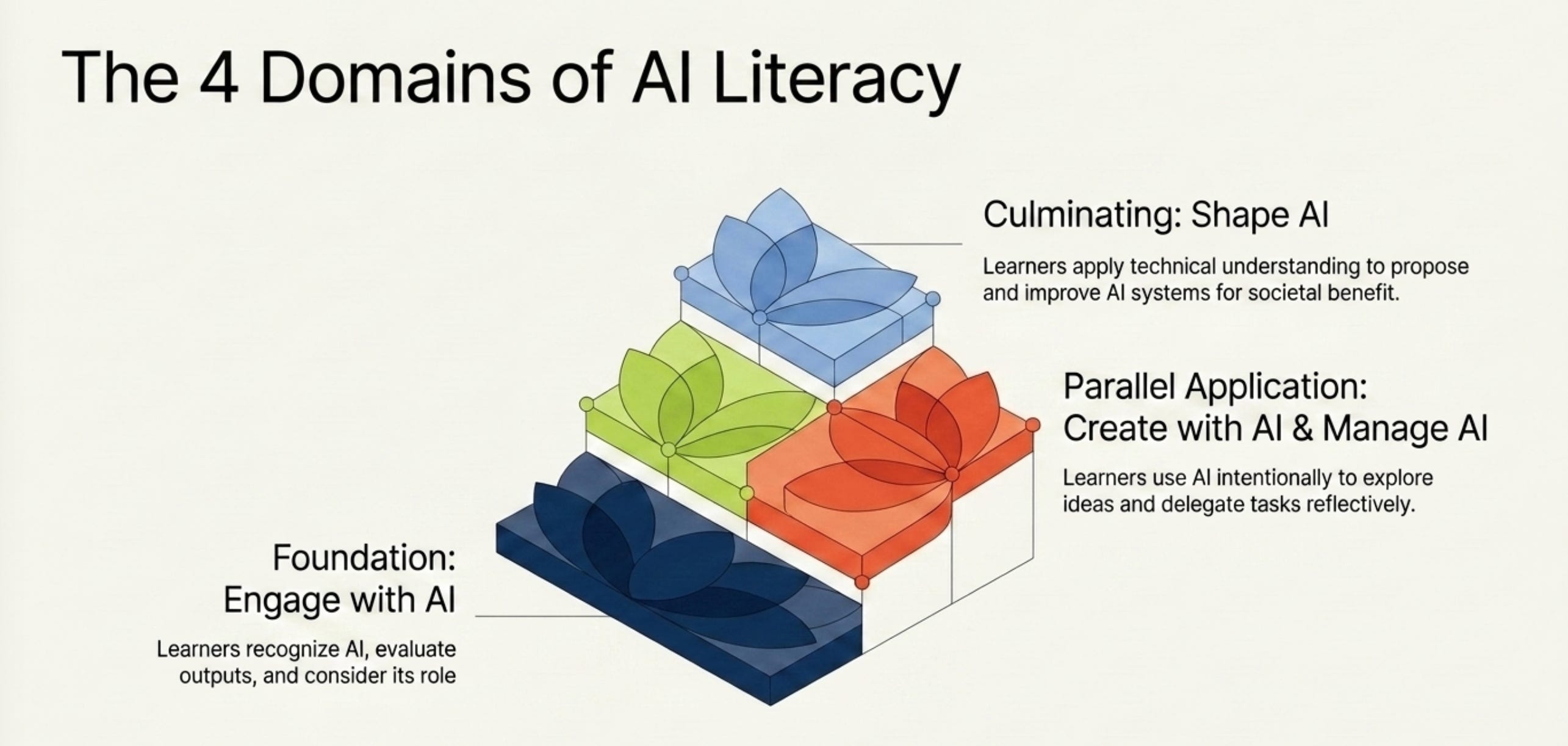
The framework organises AI literacy into four domains, presented sequentially to reflect a potential learning progression. Each domain encompasses a set of competences — concrete descriptions of the key understandings and actions that support learners’ ability to thrive in contexts shaped by AI.
Domain 1: Engage with AI (Foundation)
“Become a critical and responsible participant in a world marked by AI.”
This foundational domain establishes what all learners should know and be able to do as they encounter AI across contexts. Its seven competences address: recognising AI’s role and influence in daily life, describing AI systems without anthropomorphism, evaluating AI-generated outputs, understanding how predictive systems shape access to information, comparing the environmental impact of AI systems, analysing how AI can amplify societal biases, and evaluating AI use against ethical principles.
The framework emphasises that AI literacy is distinct from AI tool use: “Simply interacting with AI tools neither develops nor depends on the knowledge, skills or competences detailed in this framework.”
Domain 2: Create with AI
“Use AI as a creative partner while maintaining human agency.”
Four competences position learners as imaginative creators who use AI to explore open-ended questions and develop novel ideas. The emphasis is on iterative use — brainstorming, articulating ideas, reflecting on AI outputs, and refining them — while maintaining the primacy of the learner’s own creative vision. Learners also grapple with ethical questions around originality, intellectual property, and fair use.
Domain 3: Manage AI
“Divide work intentionally between humans and AI.”
Four competences place learners as intentional decision makers who carefully consider how work is delegated between humans and AI systems. This includes deciding whether AI is needed at all, selecting appropriate AI approaches for specific tasks, breaking problems into components for optimal human-AI division of labour, and monitoring AI use throughout a process. The framework treats the decision not to use AI as a valid and competent choice.
Domain 4: Shape AI (Culminating)
“Improve AI systems to reflect human values.”
Four competences empower learners to understand the relationship between the technical underpinnings of AI systems and the human choices that shape them. Through age-appropriate exploration of computer science principles, learners investigate how AI systems work, evaluate them against defined criteria, design with attention to data and information flow, and propose improvements for human well-being. This domain is the most technically demanding and requires scaffolding from the preceding three domains.
THE ARCHITECTURE OF A COMPETENCE: KNOWLEDGE, SKILLS, AND ATTITUDES
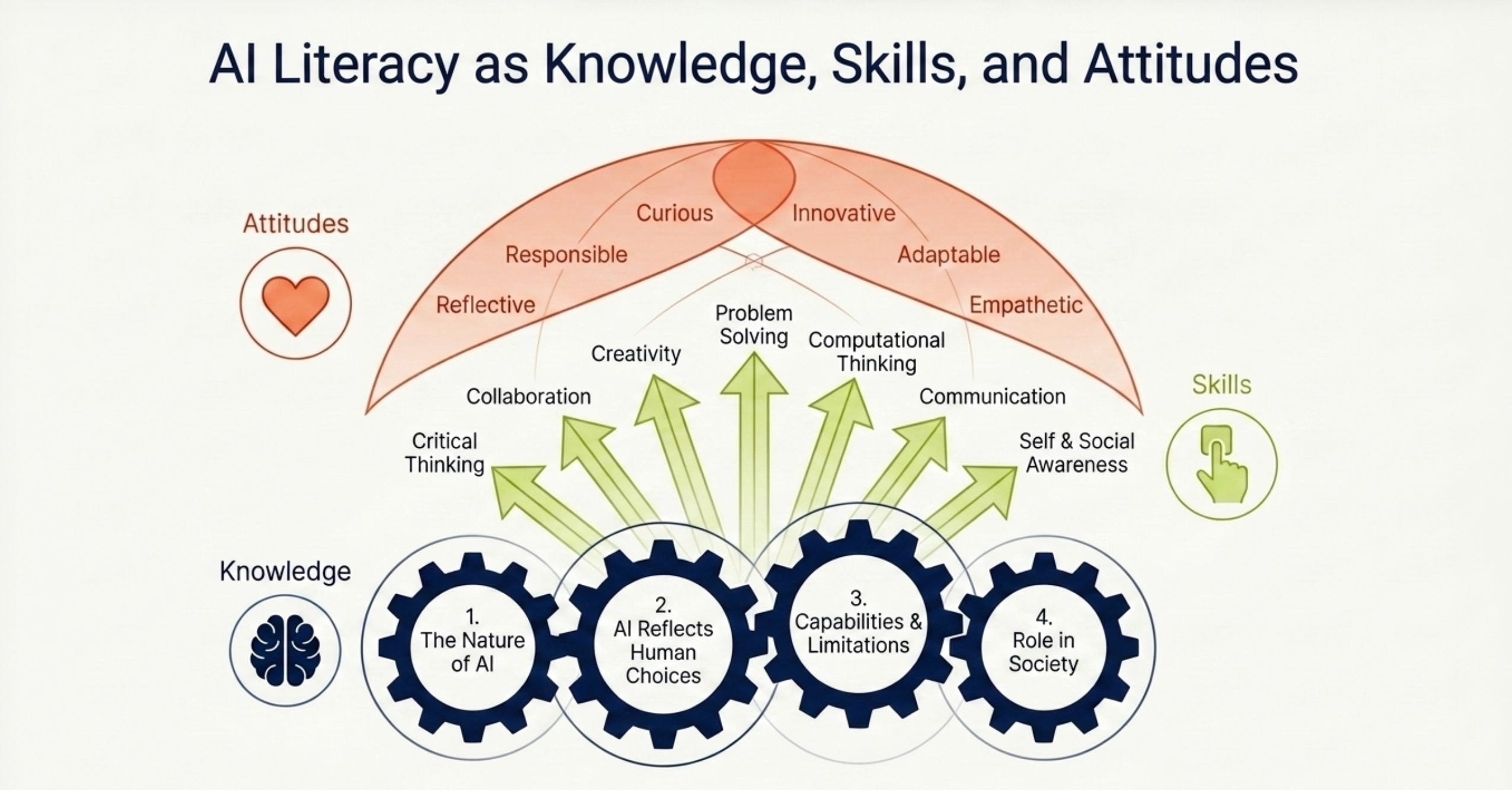
Each of the 19 competences across the four domains is grounded in a three-part structure. Competence statements explicitly map back to the Knowledge categories and the Skills and Attitudes they draw from.
Knowledge (Four Categories)
The framework identifies four categories of knowledge that learners need to apply and engage with AI systems:
1. The Nature of AI — AI systems use algorithms and statistics, not human understanding. They operate with varying autonomy and require significant energy and natural resources.
2. AI Reflects Human Choices and Perspectives — AI systems are built by humans, trained on real-world data, and reflect human assumptions, biases, and labour practices.
3. AI’s Capabilities and Limitations — AI excels at pattern recognition and content generation but lacks ethical reasoning, critical thinking, context, and genuine understanding.
4. AI’s Role in Society — AI influences decisions across domains of daily life and must be understood, audited, and regulated to maximise benefits and minimise harm.
Skills (Seven Human Capabilities in AI Contexts)
These are not technical skills specific to AI engineering. They are fundamental human capabilities that take on new significance when applied to interactions with AI systems. Each is anchored by a core question:
- Critical Thinking — How do I know if using AI is relevant, appropriate, or responsible?
- Collaboration — How can I use AI iteratively and intentionally to accomplish a goal?
- Creativity — How did my idea grow or change with AI?
- Problem Solving — How do I know that AI is the right tool for the task at hand?
- Computational Thinking — How do I frame my problem so that AI can help solve it?
- Communication — How can I describe AI for myself and others without anthropomorphism?
- Self and Social Awareness — How does AI impact me, my classmates, my community, and the environment?
Attitudes (Seven Mindsets)
The framework identifies seven attitudes that prepare learners to approach AI with awareness and intentionality. These are not fixed personality traits but dispositions that education can cultivate. Learners may embody multiple attitudes simultaneously or prioritise them differently depending on the situation:
- Reflective — Questions assumptions about AI, weighs opportunities and risks.
- Responsible — Accountable for choices, considers intended and unintended effects.
- Curious — Eager to explore what AI can and cannot do.
- Innovative — Sees themselves as empowered creators, not just consumers.
- Adaptable — Shows perseverance and flexibility when working with AI.
- Empathetic — Examines AI’s impact through others’ perspectives.
BUILT-IN ASSESSMENT: LEARNER EXPECTATIONS AT THREE LEVELS
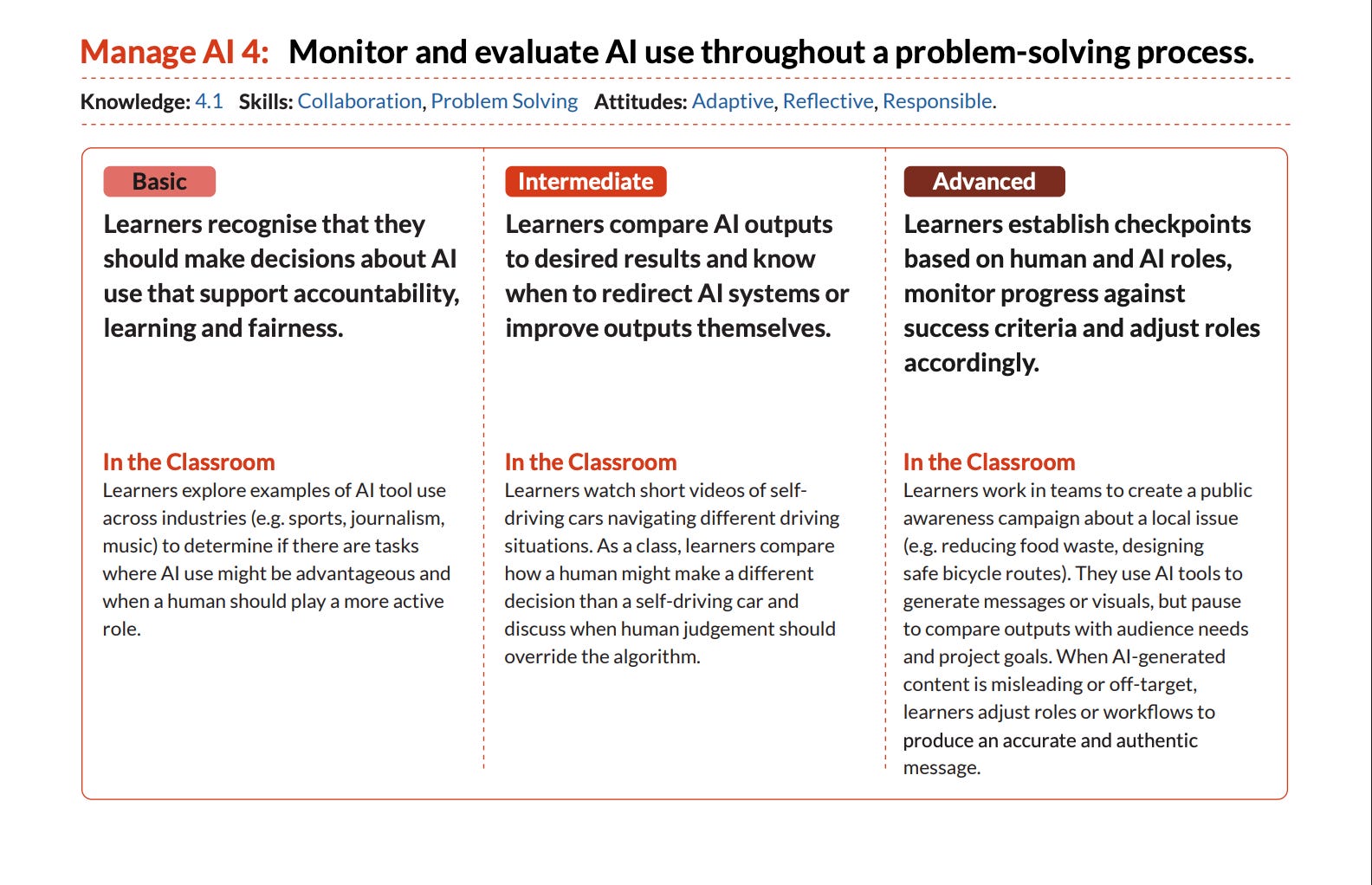
One of the framework’s most practical features is its inclusion of Learner Expectations broken into three developmental levels for each competence:
- Basic — Foundational awareness, identification, and recognition.
- Intermediate — Application, comparison, and explanation.
- Advanced — Analysis, evaluation, and independent judgement.
These levels are deliberately not tied to specific grades or age ranges, recognising that learners enter with different background knowledge about and exposure to AI. The progression provides scaffolding so teachers can meet learners where they are and design instruction that advances their confidence at the appropriate pace.
CLASSROOM EXAMPLES: FROM THEORY TO PRACTICE
Every competence is accompanied by concrete “In the Classroom” Learning Scenarios that illustrate how the framework can be applied across grade levels and subject areas:
WHO THE FRAMEWORK IS FOR
The AILit Framework identifies five key stakeholder groups, each with distinct but connected roles:
- Teachers and Educators — Facilitate informed, critical, and creative engagement with AI across grade levels and subject areas.
- School and System Leaders — Implement initiatives, build partnerships, and strengthen capacity for AI literacy across their community.
- Education Policymakers — Create forward-looking policies that prepare learners for a changing world while upholding governance and ethics.
- Learning Designers and Training Providers — Translate AI literacy goals into curricula, assessments, and professional learning experiences.
- Parents, Families, and Caregivers — Guide responsible use and foster conversations about AI’s role in young people’s lives.
The framework emphasises that AI literacy cannot be the responsibility of a single educator or subject area. It requires coordinated effort across the entire education ecosystem.
MAKE IT YOURS!
In my opinion, this framework stands out compared to others because it is:
- Both comprehensive and manageable
- Rooted in reputable expertise
- Adapated to and actionable by K-12 institutions
What is more, the framework is licensed under CC BY 4.0, so it can be freely used, translated, shared, and adapted to schools’ unique contexts.
The full PDF is available for download at ailiteracyframework.org, and an interactive online explorer allows users to filter competences by context and explore each competence’s progression, classroom applications, and the knowledge, skills, and attitudes that inform it.
The AILit Framework does not claim to be the final word on AI literacy. It describes itself as a starting point — a non-binding document intended to support, not mandate. But it is arguably the most comprehensive, rigorously developed, and practically oriented framework for K-12 AI literacy available today. For anyone working at the intersection of education and artificial intelligence, it is an essential reference.
Disclaimer. AI agents were used to process the report and draft this article.